
- NEWS RELEASE From: Canton Histo...
- NEWS RELEASE From: Canton Historical Museum 11 Fron...
- NEWSLETTER CANTON HISTORICAL MUSEUM 11 Front Street Collinsville, CT 0...
- CEMETERIES OF CANTON – 2010 There are eight cemeteries in t...
- ...
- April 23, 2009 GENERAL STORE REOPENED CEREMONIOUSLY &...
- Renovations and New Exhibits The Children's Room at the museum was...
- Whatzit? This area contains an image of an item that is within the mus...
- 2013-2014 OFFICERS & BOARD OF DIRECTORS President – D...
- A collection of Paleolithic Native American artifacts has been donate...
- Looking for images from Canton's past? We have them. We i...
- An Unsung Heroine Volumes are written about the soldier’s li...
- A descendent of Elder William Brewster of P...
- George Washington Flint's family moved from...
- Chauncey Gay Griswold, son of Elijah Griswo...
- William Edgar Simonds was born in Canton, C...
- Mercy Humphry (click here) Dr. Solomon Everest (click here) For fo...
- Are you interested in helping out? The Canton Historica...
- Stop by the large Regina music box . ...
- The Fisk coffin shown here is a very rare item from the 1850’...
- Mustache Cup Exhibit ...
- "It has been said that our manufacturing villages have a demorali...
- In the Collins ro...
- Our Victorian era display has many mannequins dressed in the clothing...
- The museum library has a wealth of information about town history, ge...
- ...
- On the upper level, built over the former bowling alley, is a r...
- ...
- The McClellan saddle, named for the ...
- Post Office and General Store General stores carried every kind of m...
- Local doctors used the items in this case. There is a...
- In this area are many items related to the production, use and re-us...
- In the glass gun case is a John Br...
- The Canton Public Golf Course has ...
- The 1854 fire engine was pulled by men, not horses. I...
- Complete with a figure of Grandma ...
- Bridal Parlor - Naomi Moulton is researching the owners of ...
- Five or six blacksmiths were kept busy making all sorts of iron fixt...
- Our Victorian barbershop contains, besides the three old barber chai...
- The lower level contains a large collection of 18th a...
- Our Bandstand display heralds the Collinsville bands that were part of...
- TO SEE OUR GIFT SHOP BOOK INVENTORY CLICK HERE Dick Iken in th...
- The Canton Historical Society, Inc. is an all-volunteer organization r...
- Ice was the second largest export from the U.S. in th...
- Bandstand Barber Shop Blacksmith Bride's Parlor Cast Iron Cof...
Stay connected with the Canton Historical Museum by becoming a fan on facebook! Click here or icon to visit |
| September 2010 Newsletter |
|
|
|
|
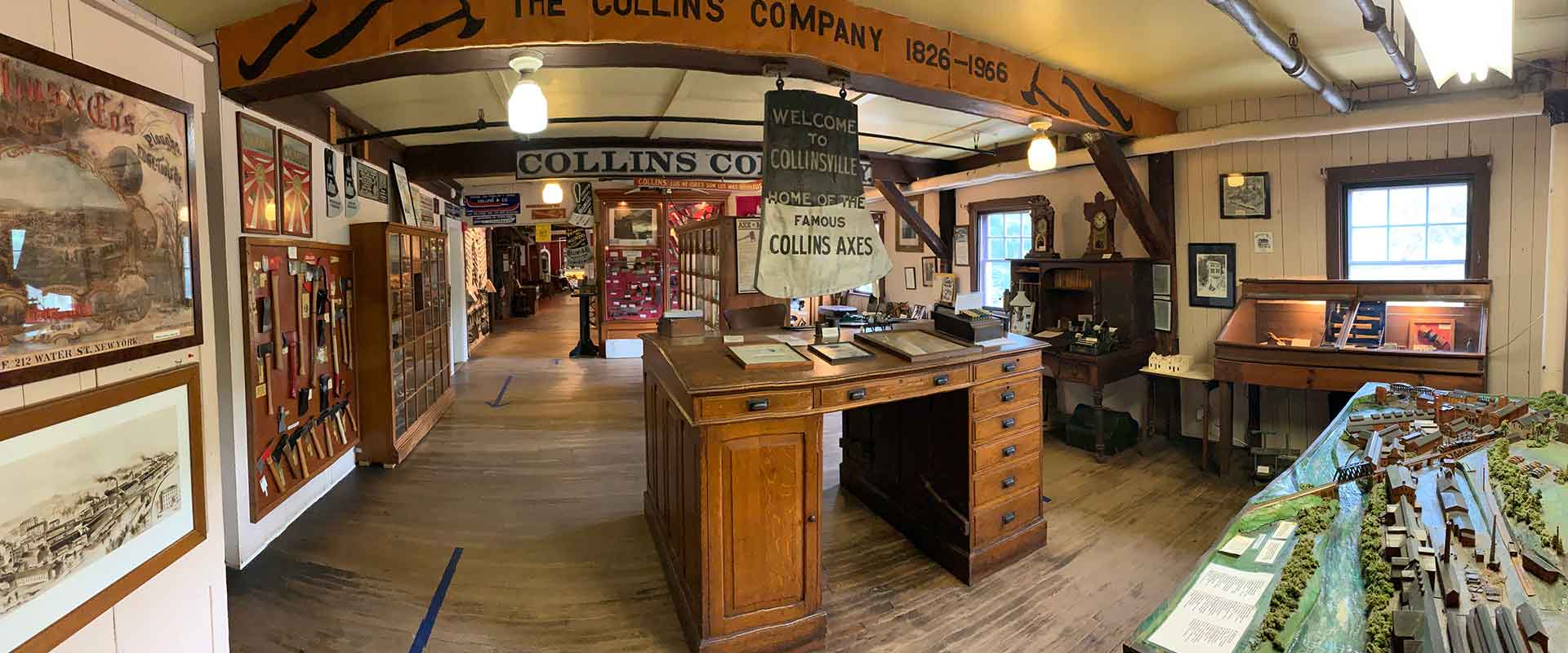
NEWSLETTER CANTON HISTORICAL MUSEUM 11 Front Street Collinsville, CT 06019 This e-mail address is being protected from spam bots, you need JavaScript enabled to view it www.cantonmuseum.org September 2010 SAM COLLINS DAY AT THE MUSEUM As in past years, the museum will join in the celebration of Sam Collins Day by holding Open House from 10:00 a.m. to 4:00 p.m. Hot dogs and soda will be on sale outside the museum and light refreshments will be served inside. Several artists from the Gallery on the Green will be showing their art work. The Gallery is celebrating its 50th anniversary. There will be an old-time photo opportunity with Victorian clothing available to dress up in, and for children a slide has been donated by Michael Pratt of Bounce About: An Inflatable Company. The slide will be located across the street from the museum toward Main Street. These last two activities are fund raisers for the museum building fund. At 1:00 p.m. David Leff will conduct a walking tour of Collinsville starting from in front of the museum. Come join us. Admission to the museum is free, but donations are welcome. A shuttle bus runs regularly from the main site on Canton Springs Road to Collinsville. GALLERY OF TREES This was instituted last year by Marge Harmon as a fund raiser for the building fund and was not only financially successful, but for several weeks the museum was transformed into a fairyland of lighted trees, and it will be the same this year. For all who are interested in participating, trees may be brought to the museum on November 13 and 14. The trees must have a theme, be artificial, and from tabletop to 6 feet. This again is a fund raiser for the building fund, and businesses and individuals are urged to join in this effort. The trees will be on display starting with the Christmas Boutique on November 20 until December 12 from 10:00 a.m. to 4:00 p.m. The drawing for winners will be held at 4:00 p.m. on December 12. There will be a Gallery of Trees Gala on the day of the Boutique, November 20, at the museum at 7:00 p.m. to showcase the trees. CHRISTMAS BOUTIQUE Our traditional Christmas Boutique will be held this year on Saturday, November 20, from 10:00 a.m. to 4:00 p.m. with a large selection of holiday items for your shopping pleasure plus items from our Gift Shop. Fresh wreaths will be made by Joann Jurgen, Marcy Campbell and Helen Kilburn. Those made last year by these talented ladies sold well. There will also be a bake sale. Being just before Thanksgiving there will be a concentration on traditional pies, such as apple and pumpkin.. Any donations of gift items or pies will be greatly appreciated. The Boutique is a major fund raiser for the operating expenses of the museum. The 2011 Museum Calendar will not be available this year until December 12 -- the day for the drawing of the Gallery of Trees. ALPINE HOLIDAY TO BENEFIT MUSEUM Harmon Travel is sponsoring a tour through Collette Vacations that will benefit the museum at $50.00 per reservation. This exciting adventure will cover the Christmas markets of Austria and southern Bavaria visiting such places as Innsbruck, Munich, Oberammergau and Salzburg. The trip is scheduled for November 26 through December 3, 2010, and the $2,199 double rate includes air fare, taxes, fees, and breakfast and dinner most days. You can pick up a brochure at the museum or contact Harmon Travel for reservations or information 806-693- 2012. To find out more about this tour and others Harmon Travel and Collette Vacations will be at the museum on September 23 at 700 p.m. to give a presentation on the Alpine Holiday as well as Costa Rica and a Tulip Trip to Amsterdam. SAM COLLINS: THE MAN WHO BUILT A VILLAGE It is well known that Samuel Watkinson Collins started the Collins Company in 1826 for the manufacture of axes and small edge tools, but his legacy will also be that he built a village. When he and his brother David and cousin William Wells negotiated to buy the Humphrey grist mill and saw mill on the Farmington River in what was then South Canton, the area was virtually virgin forest covered with trees and outcroppings and unpopulated except for the Tim Case Tavern and farm located near the river and the Correll Humphrey house. The venture started because William Wells had a small shop with several blacksmiths making axes by hand in Hartford but there was no water power. Their idea was to mass produce axes that would be ready to use as up to this time they were made by blacksmiths and had to be honed before they could be used. Putting up $5,000 each to start, the first thing they did was to hire several blacksmiths and production started in the grist mill. Thus, the Industrial Revolution came to Canton which up to then was mainly an agricultural town. Sam Collins was 24 years of age. David Collins was younger and William Wells was 21, and while they both served in different capacities in the fledgling company, they died at an early age. David Collins resigned in 1837 and died not long after from consumption. William Wells died in 1831. Sam Collins continued on, renowned for his innovativeness in the manufacture of edge tools, and the business became known throughout the world with a reputation for the excellent quality of its products. The early years were not easy, particularly financially, and throughout the years the Farmington River flooded its banks wreaking havoc with the factory buildings. The 1955, 100-year flood was so damaging that it was a major factor in the demise of the company. In 1827 the first factory building was built, a two-story building made with stone quarried from where the Collins Company office building now stands on Front and Main Streets. By 1828 the building was completed and all grinding, polishing, blacking and boxing were done in this building. Also during this time Sam Collins had three houses built on what is now Front Street, and in April of 1828 moved with his family from Hartford into one of the houses. He had been boarding a mile up the river at the Pettibone house on the Litchfield Turnpike and walked to work. On Sundays he traveled to Hartford to visit his family. At this time he contracted to have the four-horse stage coach taken off the Albany Turnpike and run through Collinsville thereby getting a post office established. Two boarding houses were built on Front Street north of Main Street. He also sold some land to Orwell Brown who built a store on Main Street, and before an office building was built, a space on the upper floor was used as the company’s office. In 1830 the first office building was put up on the site where the stone was quarried for the stone building. It was a two-story wooden structure, with a lower part used as a school for children while the second story was used for many years as the only public hall in the village, and on Sundays was used as a chapel until the Congregational church was built in 1836, but it continued to be used by other denominations. In this year he purchased land for a Congregational church. Meanwhile, the factory operations grew and flourished. Having taken care to make a superior quality of work, the demand increased rapidly. The greatest obstacle to increased production was a shortage of housing and skilled labor. Advertisements were circulated in and out of Connecticut for workers, and they came lured by the advertised wages and hours. To accommodate the growing work force 21 double houses were built in 1831 all of one size and plan on the east side, each with a fireplace. Bridges were built across the canal which had formerly been a section of the river, and across the main river at the company’s expense to open building ground for housing, and the deed was given to the Town of Canton for the highways and bridges without charge. Following that 24 houses were built on the west side of the river identical to the ones on the east side. More than half of them became occupied by workers from Massachusetts. In 1838 the company built houses on what is now Torrington Avenue. In 1836 the Tim Case Tavern and adjoining farm was bought. The purchase of the tavern was especially desirable to Sam Collins in his effort to suppress gambling and drinking. Because it was a problem in factory production, there was a clause in the workers contract about the consequences of being caught intoxicated. The purchase also enabled raising the dam and pond the following year. To improve access to the village a road was opened to Unionville on west side of river on December 2nd and a mile of new road opened shortening the distance to Canton Village starting in Collinsville following Ned’s brook and coming out on the Litchfield Turnpike (now Old Canton Road/Simonds Avenue). Later, a new road was built connecting Collinsville to Unionville on the east side, now New Road. In he financed the First Congregational Church which burned in 1857 and he again contributed to that, and he gave land for the Village Cemetery where he is buried. In the same year he had elm trees planted along the streets to beautify the town which they did with their arching boughs for many years until they succumbed to the Dutch elm disease in the next century. The Town of Canton was incorporated in 1806, having previously been part of Simsbury and called West Simsbury. In the ensuing years the seat of government was in Canton Center and whoever was town clerk housed the town records in his home. In 1838 the town clerk’s house burned to the ground along with town records. Early post offices were also housed in the home of the postmaster. The town has four sections or villages, delineated by these post office districts: Canton Street or Village, North Canton, Canton Center and Collinsville. In 1850 Sam Collins bought land on the West side of the river and built a 23-room mansion and moved in February 1851. He could no longer stand the noise of the factory and bustling community. In 1850 the Canal Line of the New Haven Railroad came to town under his financial persuasion, and in 1854 he provided land for the Collinsville High School which earned an excellent reputation. Its curriculum included Greek, Latin, German and French. By this time an elementary school had been built. In 1869 he had the Valley House Hotel built for visiting businessmen. They would now arrive by train and stay at the hotel. The Central New England (CNE) had also come to town by way of Simsbury from Hartford. A person could board a train at any of the four depots in Collinsville, Dyer Avenue, Cherry Brook and Canton Street and go anywhere within the state and country. As the company grew, so did the village. In addition to the duplex houses, tenement houses were built on both sides of the river, and houses were built for executives around The Green, shaded by the elm trees in summer. In 1864 a two-tenement concrete house was built on Spring Street. In 1867 a new three-story office building was built on Front and Main Streets of Portland brown stone. The previously built wooden structure was moved to River Street and turned into tenements. The post office was now located in the lower level facing Main Street. It continued to provide a hall for public and church events as well as a public library. Another addition to the Collins Company was the making of plows. Francis F. Smith from Indiana had invented a plow (plough) specifically suited to the hard soil of the Midwest but could find no one to manufacture it, even in England, until he came to town and proposed it to the Collins Company. They agreed to make it, and at their peak were manufacturing 100 plows a day. He became known as Plow Smith. In 1850 a building was erected for painting and getting the plows ready for shipment. In the 1920s when the demand for plows lessened, although the company continued to make them on order, they turned the building into a recreational facility for employees with a reading room and rifle range. The second floor was turned into a bowling alley which was open to the public. The building is now owned by the Canton Historical Society and houses the collection of the Canton Historical Museum. Because there was a shortage of skilled iron workers being mostly farmers in the area, the company advertised widely not only in this country, but abroad and so by mid-century workers were coming from Canada, Sweden, Finland, Germany, Ireland, Poland, and other Slavic countries. Businesses sprang up to serve the growing population: Collinsville Savings Society, Union Bank, grocery stores, clothing stores, meat markets, doctors, lawyers, inns and boarding places, but no taverns. And the different denomination and ethnic groups built churches: St. Patrick Catholic Church, St. Mathew Lutheran Church, Trinity Episcopal Church, Pilgrim Evangelical Swedish church where ministers spoke Swedish, and a Methodist church which did not last long and served as an opera house and town hall until it was demolished for the Canton Public Library in 1913. In 2010 the village of Collinsville looks as it did in Sam Collins day. It is listed on the National Register of Historic Places because it is unchanged as an example of a 19th century mill town. The Collins Company closed in 1966: the last whistle stopped blowing, the trip hammers stopped thumping. They could be heard miles away. It was as though the heart of the village stopped beating. The two trains systems had long since stopped running, and the village went through several years of decline. There was an effort to revitalize it by putting up modern buildings and tearing down the Town Hall and blocks on Main Street, but it was defeated, narrowly, by voters. It is now thriving with activity of a different kind and time with visitors reveling in its old-time charm and commenting how fortunate we are. Samuel Watkinson Collins was born in 1802 and died in 1871. He had one surviving son, Howard, who had two daughters. There were no heirs, but Sam Collins left us a village. Kathleen R. Woolam, Curator MUSEUM TO HAVE BOOTH AT THE BIG E On Wednesday, September 29, the museum will have a booth in the Connecticut Building at the Eastern States Exposition through arrangements made by board member Charles Whitney. Volunteers from the museum will set up and man the booth throughout the day. From the estimated 5,000 visitors a day that go through the Connecticut building, it should generate exposure and sales from our gift shop. BOOTH AT FARMERS MARKET The museum has had a booth at the downtown Collinsville Farmers Market since it started earlier in the summer on Sunday mornings until early afternoon. Manned by volunteers from the museum, there have been varying reports of success in selling items from the Gift Shop, but regardless of sales there is always an effort to get people to visit the museum which does pay off. HELEN KILBURN: THE CALENDAR LADY Helen will again put together the 2011 Museum Calendar despite the loss she has suffered in the death of her husband Bud in June, plus that of their daughter Linda, a few years’ ago. Helen came from Ohio and Bud met her while in the service in WWII. Bud was a home town boy who loved this town and after the war, they settled here and both of them were active throughout the years in civic affairs , organizations of all kinds, including the Canton Historical Museum and St. Mathew Lutheran Church. Bud was a successful attorney with offices in Hartford and served as a representative from Canton in the General Assembly. He continued his military career in the National Guard achieving the rank of Lt. Colonel. He never failed to march in the Memorial Day parade in honor of fallen town soldiers and he and Helen for years decorated their graves with flags. Helen expects the calendar to be ready by December 12. CINDI GRIGGS HOSPITALIZED Cindi Griggs, who we can’t do without, especially when it comes to our Indian artifacts, recently suffered a stroke, but we are happy to report that her condition is improving at the Hospital for Special Care in New Britain where she is receiving intensive therapy. Our thoughts and prayers are with you, Cindi. Messages may be sent to the Hospital for Special Care, 2150 Corbin Avenue, New Britain , CT 06053. |
Hours of Operation
(April through November)
Wednesday - Sunday 1 - 4 PM
Winter Months:
(December through March)
Saturday and Sunday 1 - 4 PM
or by special appointment.


